Psych/NPB 163
Fourier Analysis
Why frequency analysis?
- Many signals in the natural environment are conveniently described in terms of a superposition of wobbly functions (e.g., many sounds are produced by vibrating membranes).
- Sines and cosines are eigenfunctions of linear, time-invariant systems. Thus, they can be used to conveniently characterize the response of a linear system. Also, convolution, which is a complicated signal transformation in the time or space domain, is performed by simple multiplication in the frequency domain.
The Fourier series
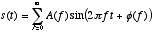
- Joseph Fourier’s theorem, in its most general form, states that any function may be described in terms of a superposition of odd and even functions. Specifically, Fourier proposed that a signal may be decomposed into a summation of sinewaves of different frequencies, amplitudes and phases:
 .
.
- What is remarkable about this is that
 can be anything- the waveform produced by a bird chirping, the sound of your dishwasher, electromagnetic waves, etc.
- The amplitudes
 tell you how much of each frequency is present in the signal. For example, a pure tone (e.g., the waveform emitted by a tuning fork) would have
  equal to zero for all frequencies except for one. The sound produced when you say “shhh” would have amplitudes distributed across many frequencies.
- The Fourier series tells us that a sound may be decomposed in terms of sinewaves, but it doesn’t tell us how to do it - i.e., it doesn’t tell us what amplitudes A to assign to each f. For this we need the Fourier transform.
The Fourier transform
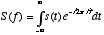
- The Fourier transform basically provides a way of representing a signal in a different space - i.e., in the frequency domain. You put into the Fourier transform a function of time or space,
 , and you get out a function of frequency,
  . The Fourier transform is formally defined as follows:
 .
.
- Thus, the Fourier transform is essentially the inner-product of the signal
 with the complex exponential
  , evaluated at different values of f.
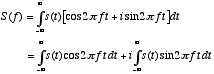
- The complex exponential is just a real cosine-wave and an imaginary sine-wave:
 .
.
Thus, the Fourier integral may be written alternatively as
- Here we can see that
 is a complex number. The real part tells us the result of multiplying our signal together with a cosine-wave, the imaginary part tells us the result of multiplying the signal together with a sine-wave.
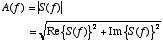
- The amplitude A of each frequency component contained in
 is given by the modulus of S, which is defined as
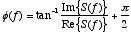
- The phase
 can be extracted from the ratio of the real an imaginary components of
  as follows:
Convolution theorem
- The convolution of two functions,

may be performed in the frequency domain via multiplication:
 .
.
where  ,
,  , and
, and  are Fourier transforms of
  ,
,  , and
, and  respectively.
- That this is so is due to the fact that 1) sines and cosines are eigenfunctions of linear time-invariant systems, and 2) any function may be represented as a sum of sines and cosines.